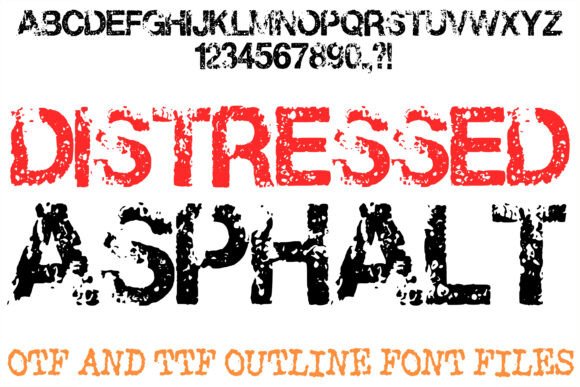
Distressed Asphalt Font Review
There I was, staring at a blank brand board, trying to find the right visual language for a new artisanal café concept. The client wanted something that felt grounded, authentic, and unpolished—like a place where coffee was made with heart, not just precision. That’s when I pulled out Distressed Asphalt. It wasn’t the first font I tried, but it was the one that immediately made me feel like I was looking at a real-world sign, weathered by time and use.
Distressed Asphalt for Brand Identity and Logo Design
Distressed Asphalt is a Display font that doesn’t shy away from its rugged roots. Each character has a tactile quality, as if it were carved into a road surface or etched onto a metal sign. This makes it ideal for brand identities that want to convey a sense of authenticity, grit, or industrial charm. In logo design, it works best when used in short phrases—think taglines, names, or single-word branding elements.
I tested it on a logo draft for a local bakery that prides itself on using traditional methods. The font added a layer of storytelling, making the brand feel more like a neighborhood staple than a corporate entity. It paired well with a simple sans serif for the subtitle, creating a balance between raw energy and clean readability.
Distressed Asphalt for Packaging Design and Product Labels
When I placed Distressed Asphalt on a packaging mockup for a handmade soap line, it brought an immediate sense of craftsmanship. The font’s irregular edges and uneven strokes mimicked the texture of hand-poured wax or rough-hewn wood, which aligned perfectly with the product’s aesthetic. It worked especially well on labels that needed to stand out on a shelf without overwhelming the design.
However, I noticed that in smaller sizes, some characters became harder to read. For example, the 'g' and 'q' had a slight slant that could be confusing if not spaced carefully. This means it’s better suited for larger text blocks, such as headers or signage, rather than detailed product descriptions.
Distressed Asphalt for Web Design and Social Media Graphics
In web design, Distressed Asphalt shines as a headline font. I used it on a homepage hero section for a creative studio, and it instantly gave the page a bold, energetic vibe. The font’s unique shape helped it stand out against a minimalist background, making the call-to-action more memorable.
On social media layouts, it worked well for Instagram posts and Facebook banners. The font’s personality added a layer of visual interest without needing additional graphics. But again, I found that it was most effective when used sparingly—too much of it could make the design feel cluttered or chaotic.
Distressed Asphalt for Business Cards and Printed Materials
Testing Distressed Asphalt on a business card for a local event planner, I was impressed by how it held up in print. The font’s texture added depth, making the card feel more substantial. It paired nicely with a subtle pattern in the background, reinforcing the brand’s connection to real-world experiences.
One thing to note: if you’re printing this font, make sure your printer can handle the weight and detail. Some low-quality printers might not render the fine lines and textures as intended, which could dull the font’s impact.
Distressed Asphalt for Editorial and Commercial Design Assets
For editorial design, Distressed Asphalt worked well as a decorative element. I used it on a magazine spread about urban culture, and it complemented the theme perfectly. Its industrial feel matched the content, giving the layout a cohesive, thematic edge.
In commercial design, it’s best used as an accent rather than a primary typeface. It can add a unique touch to posters, flyers, or promotional materials, but it shouldn’t be relied on for long paragraphs of text. Its strength lies in its ability to draw attention, not in its legibility over extended reading.
When considering Distressed Asphalt for any project, always test it in the context of the final output. Whether it’s a website, a print ad, or a packaging label, seeing the font in action will help you understand its true potential and limitations. And remember, while it’s a powerful tool, it’s not a one-size-fits-all solution.