Kensington Parlor Font Review
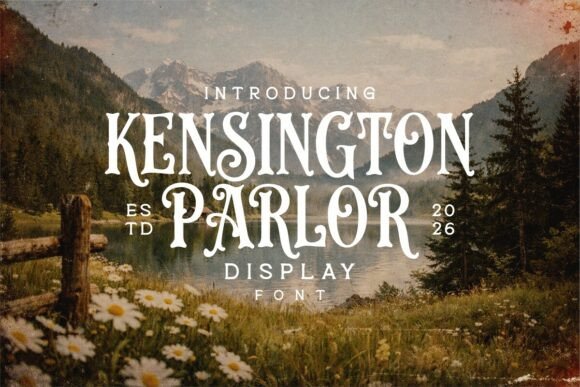
Opening a blank brand board, I was looking for a font that could bring a sense of old-world charm to a new boutique coffee shop’s identity. The client wanted something that felt both elegant and grounded, like the kind of typography you’d see on a vintage train ticket or a handwritten menu. That’s when I reached for Kensington Parlor, a display font that promises to transport your audience to a world of vintage charm and scenic grandeur.
Kensington Parlor for Boutique Branding and Coffee Shop Identity
Kensington Parlor is a display font that exudes Victorian-inspired elegance with a rustic, adventurous spirit. It’s not just a typeface—it’s a mood, a story, and a visual cue that speaks to a bygone era. When I tested it on a logo concept for a new café, the result was immediately evocative. The delicate serifs and slightly irregular stroke weights gave the design a handcrafted feel, perfect for a small business that prides itself on authenticity and warmth.
The font works best as a headline or accent font, rather than a body text solution. Its intricate details make it less suitable for long paragraphs, but as a logo or tagline, it adds a level of sophistication that’s hard to match. On a packaging mockup, it stood out without overwhelming the design, blending seamlessly with a muted color palette and natural textures.
Kensington Parlor for Packaging Design and Product Labels
When I placed Kensington Parlor on a product label for a handmade soap line, the font brought an unexpected sense of refinement. It balanced the rawness of the product with a touch of class, making the brand feel more polished while still maintaining its artisanal roots. The swashes and ligatures in the font added a subtle flair that made the labels feel more personal and intentional.
It’s important to note that the font’s decorative elements can be distracting if overused. In packaging design, it’s best to use it sparingly—perhaps as a main headline or a secondary tagline. Pairing it with a clean sans serif for product descriptions helped maintain readability without sacrificing style.
Kensington Parlor for Social Media Graphics and Web Headers
Testing Kensington Parlor on a social media layout for a local bakery revealed its versatility. As a header for a promotional post, it caught the eye and set the tone for a campaign centered around nostalgia and tradition. The font’s boldness made it stand out against a background of warm, earthy tones, while its ornate details added a layer of visual interest.
On a website header, it worked well as a focal point, especially when paired with a minimalist design. However, I noticed that on smaller screens or mobile devices, the font’s fine details could become less legible. For web use, it’s best to limit its application to large text areas where it can shine without compromising clarity.
Kensington Parlor for Business Cards and Print Materials
A business card is one of the most intimate ways a brand communicates with its audience. When I used Kensington Parlor on a card for a creative studio, it instantly elevated the design. The font’s character and personality made the card feel more personal, as though it had been crafted by hand rather than printed from a template.
But there are limitations. In smaller sizes, the font’s details can become too fine, leading to reduced legibility. For print materials, it’s best to use it at a minimum size of 18pt or larger. Even then, it’s important to test it on different paper stocks to ensure it doesn’t lose its sharpness or clarity.
Kensington Parlor for Editorial and Poster Design
In editorial design, Kensington Parlor proved to be a strong choice for headlines and pull quotes. Its Victorian aesthetic fit well with a magazine spread focused on travel and storytelling. The font’s ability to convey a sense of history and adventure made it ideal for a feature on heritage tourism.
For a poster promoting a local art exhibit, the font added a sense of occasion and exclusivity. It worked well alongside a bold sans serif for subheadings, creating a dynamic contrast that drew the viewer’s eye. However, I found that using it in longer text blocks led to a cluttered look, reinforcing the idea that it’s best suited for short, impactful phrases.