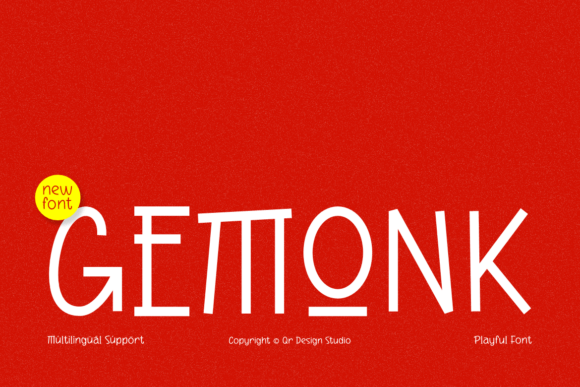
Gemonk Font: Bold, Unconventional, and Full of Personality
There I was, staring at a blank brand board, trying to find a font that could match the wild energy of a new boutique café concept. The client wanted something that felt alive, something that didn’t just say “coffee” but whispered “adventure.” That’s when I reached for Gemonk—a display font that refuses to play it safe. It’s not your average typeface; it’s a visual punch of eccentric charm and raw creative freedom.
Gemonk for Logo Design and Brand Identity
Testing Gemonk on a logo draft was like watching a spark ignite. The font’s irregular shapes and playful curves brought an unexpected energy to the mark, making it feel less like a standard logo and more like a signature. It worked especially well for a café name with a whimsical twist, adding a sense of fun without sacrificing clarity. But here’s the thing: Gemonk isn’t for every brand. Its boldness can be overwhelming if not used intentionally. When paired with a clean, minimalist layout, it becomes a standout element that draws the eye without shouting.
One challenge I faced was ensuring the font didn’t overpower the rest of the design. In a brand board with multiple elements, Gemonk needed space to breathe. It thrived as a headline or tagline, but when scaled down, its details started to blur. This makes it ideal for display purposes rather than body text. Still, in the right context, it adds a unique personality that other fonts simply can’t match.
Gemonk for Packaging and Product Labels
When I applied Gemonk to a packaging mockup for a skincare product line, the results were surprisingly effective. The font’s organic flow gave the labels a handcrafted feel, perfect for a small-batch, artisanal brand. It stood out on a shelf full of more rigid, corporate designs, making the product feel more approachable and human. The font’s asymmetry also helped create visual interest, preventing the packaging from looking flat or predictable.
However, I noticed that Gemonk didn’t work as well in smaller sizes. On a label that was too tiny, the details got lost, and the overall message became unclear. This is where careful sizing and spacing become crucial. If you’re planning to use Gemonk on product labels, make sure to test it at the intended size before finalizing the design.
Gemonk for Web Design and Social Media Graphics
In web design, Gemonk made a strong impression on a homepage hero section. Its dynamic shape and lively rhythm added a sense of movement that complemented the site’s modern aesthetic. It worked best as a heading, where it could command attention without disrupting the user experience. On social media layouts, the font added a playful edge to posts, making them more engaging and memorable.
That said, Gemonk isn’t the best choice for long-form content. Its decorative nature can make it hard to read in large blocks of text. For websites, it’s best reserved for headlines, buttons, or accents. When used sparingly, it can elevate a design without compromising readability. Pairing it with a simple sans serif font helped balance the composition, allowing Gemonk to shine without overshadowing the rest of the layout.
Gemonk for Business Cards and Print Materials
A business card with Gemonk felt like holding a piece of art. The font’s expressive strokes and uneven baseline gave it a handmade quality that stood out in a stack of generic cards. It was perfect for a creative studio or independent designer looking to make a statement. However, the font’s complexity meant that it required careful kerning and spacing to look clean and professional.
I found that Gemonk worked best when used in conjunction with a more neutral typeface for contact information. This created a contrast that highlighted the font’s uniqueness while maintaining legibility. For print materials, it’s important to ensure that the font is high-resolution and properly embedded to avoid any issues during production.
Gemonk for Editorial and Commercial Design Assets
Using Gemonk in editorial design—like a magazine spread or poster—was a mixed experience. It added a sense of spontaneity and creativity that fit well with a more experimental layout. But in a more traditional publication, it felt out of place. The font’s unpredictability can be a strength or a weakness, depending on the project’s tone and audience.
For commercial design assets, such as templates or marketing materials, Gemonk can be a powerful tool when used thoughtfully. It works best for short phrases, slogans, or visual accents that need to grab attention. As with any display font, it’s important to consider the target audience and the medium in which it will be used.
Before using Gemonk in client work, I always recommend testing it across different platforms and sizes. A font that looks great on a screen might not translate well to print, and vice versa. Also, check the licensing terms carefully—especially if you’re planning to use the font in commercial projects, merchandise, or digital products.